
MUSÉE DE L’OEUVRE NOTRE-DAME
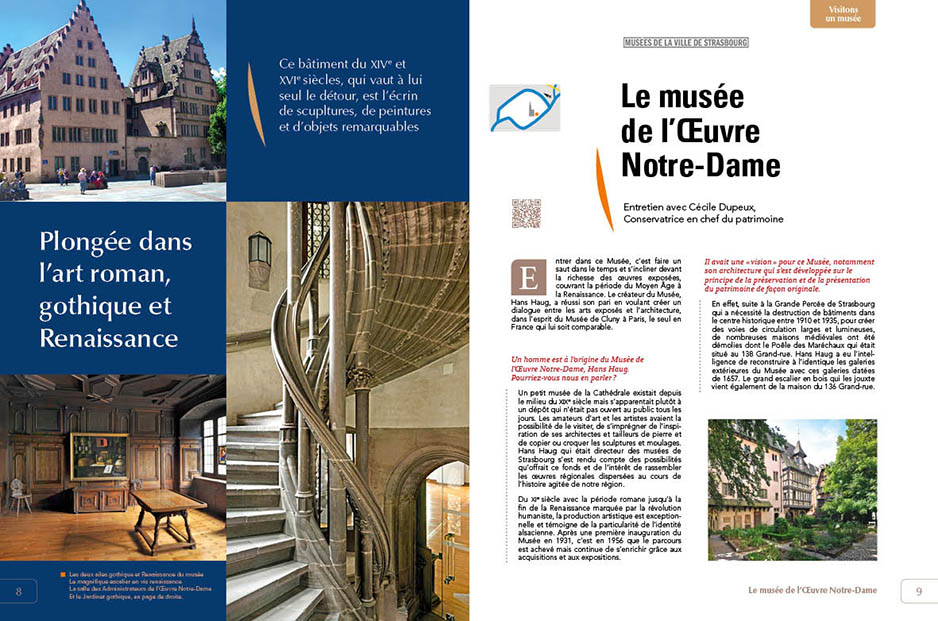
This building of the fourteenth and sixteenth centuries, which is worth the detour on its own, is a showcase of remarkable sculptures, paintings and objects. A high angle shot in Romanesque, Gothic and Renaissance art.
Entering this museum is a step back in time from the Middle Ages to the Renaissance.
The creator of the Museum, Hans Haug, wanted to create a dialogue between arts and architecture, in the spirit of the Museum of Cluny in Paris, the only one in France to be compared with.
Romanesque art occupies a large room at the entrance of the museum with outstanding pieces of Alsatian churches, such as the cloister of Eschau or the famous window « Le Christ de Wissembourg. »
The Gothic statues occupy the largest room of the museum. These are original statues, currently replaced by copies made in the workshops of the « Oeuvre Notre-Dame ». They were sheltered at the time of the French Revolution, then mainly in the early twentieth century, because of weather and also pollution from coal and exhaust. The specificity of the statues of the Cathedral is to be made of sandstone, a fragile stone.
Among other fragile works, the architectural drawings of the Cathedral have been present since 2015. They were made mostly on parchment and testify to the vitality of the building site of the Cathedral and the expertise of the « Oeuvre Notre-Dame ».
Renaissance art is particularly present with paintings and objects. These are mainly works of Rhenish art.
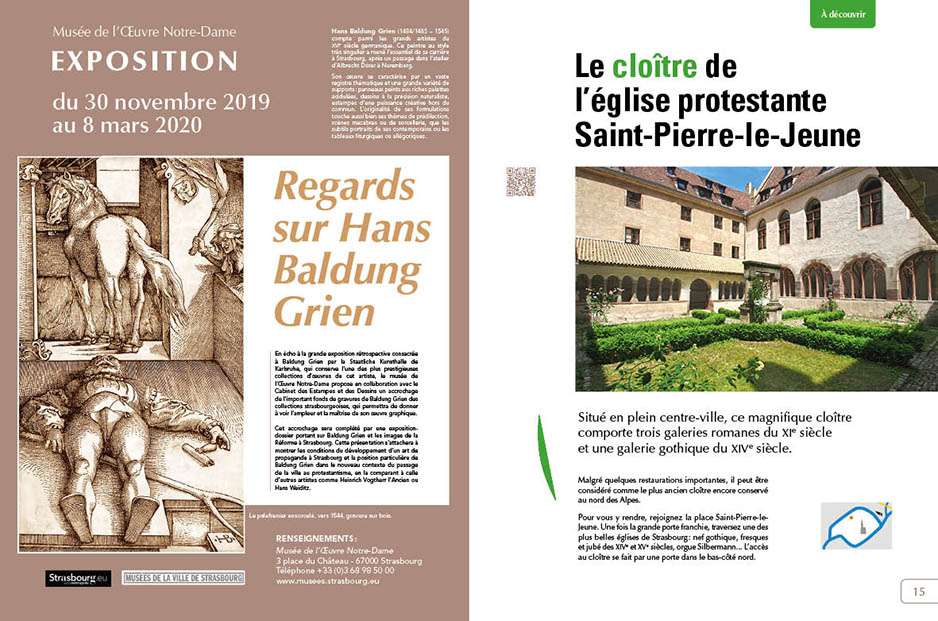
Our next exhibition will be in partnership with Karlsruhe (DE) in November 2019 about the painter Hans Baldung Grien
Musée de l’œuvre Notre-Dame – 3 place du Château – 67000 Strasbourg
www.musees.strasbourg.eu
Phone: +33 (0) 3 68 98 50 00
Price € 6.50 – reduced price: € 3.50 – Free for children under 18 years old.
LE CLOÎTRE DE L’ÉGLISE PROTESTANTE SAINT-PIERRE-LE-JEUNE
Place to discover…
Located in the city center, this magnificent cloister has three Romanesque galleries of the XIth century and a Gothic gallery of the XIVth century. Despite some important restorations, it can be considered as the oldest preserved cloister north of the Alps.
Join the place Saint-Pierre-le-Jeune. Once you have crossed the main gate, enter one of the most beautiful churches in Strasbourg : Gothic nave, frescoes, rood screen, Silbermann organ…
Access to the cloister is through a door in the north aisle.
CRONENBOURG ET KRONENBOURG
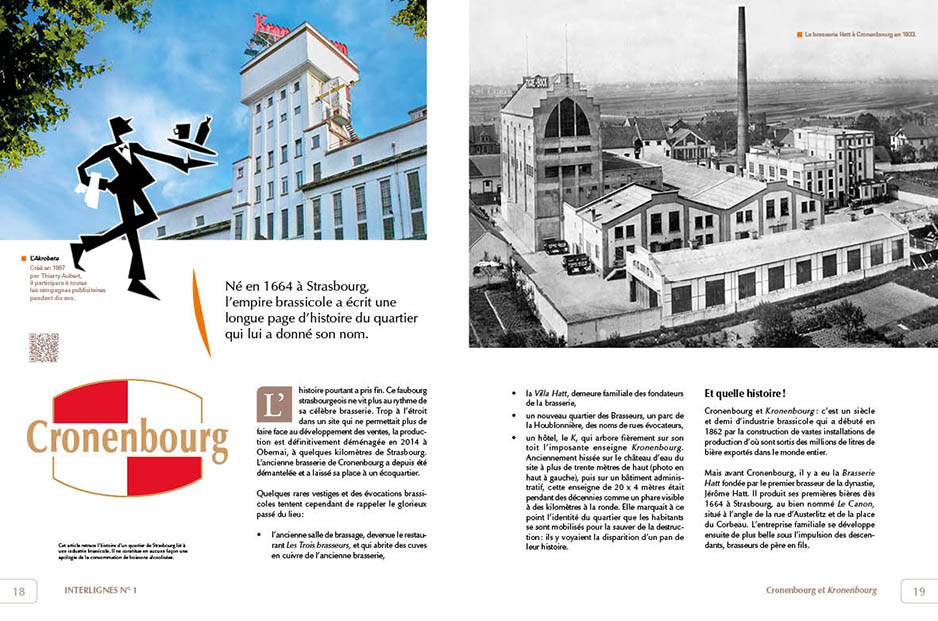
Born in 1664 in Strasbourg, the brewing empire Kronenbourg wrote a long page of history of this part of the city that gave it its name.
But before Cronenbourg, there was the « Brasserie Hatt » founded by Jérôme Hatt. He produced his first beers in 1664 in Strasbourg. Then the family business develops under the leadership of the descendants, brewers from father to son.
In 1847, Frédéric-Guillaume Hatt moved the brewery to Cronenbourg (Germanized in « Kronenburg » in 1871), and considerably enlarged the family brewery. Cronenbourg is really developing at that time.
After the First World War, Maurice Hatt, the next in line, created the « Tiger Bock », a luxury blond beer with a strong name and a graphic signature – a tiger – that captures the spirits. For the first time, a beer did not carry the name of its brewer.
It is Jérôme Hatt who invented the brand Kronenbourg. It was born on September 15, 1947 with a « K », not a « C ». He wanted to accentuate the Germanic consonance, « undeniable evocation of quality », while keeping the French pronunciation softer: « Bourg » instead of « Burg ». The red and white checkerboard, inseparable from the brand, is directly inspired by the logo of the City of Strasbourg; they are also the two colors of Alsace.
Adept of advertising and media coups, Jerome Hatt reaches the million hectoliters. He creates the famous bier « 1664 » and the first « Pack of 6 ». It is a perfect product for supermarkets. More easily transportable, the beer is consumed not at the bar but at home. A revolution ! In 32 years, Jérôme Hatt has raised his brewery to the rank of industrial empire.
But the brewery K1 in Cronenbourg, enclosed within this part of the city and deprived of extension, slows down its activity in the advantage of K2, inaugurated in Obernai in 1969, some twenty kilometers west of Strasbourg. It is the largest brewery in Europe.
In 1977, Jérôme Hatt retired from business: it was the end of the dynasty of Strasbourg brewers.
But the group continues to thrive, and joins the Danish group Carlsberg, the fourth brewer worldwide.
Cronenbourg will no longer benefit from future developments of the brand and its successes. The historic site is dismantled and there remains little evidence of the glorious brewing epic in the neighborhood : a hotel, the « K » (which carries on its roof the big logo of the old brewery), a small park « brewers », an old fermentation tank recovered by the restaurant « les 3 brasseurs ».
All of the group’s products destined to the French market (Kronenbourg, 1664, Grimbergen, Carlsberg, Skøll Tuborg, Tourtel Twist…) are now brewed in Obernai, which is celebrating its 50th anniversary this year.
LES FONDATIONS DE LA CATHÉDRALE
A lake, a legend, the reality…
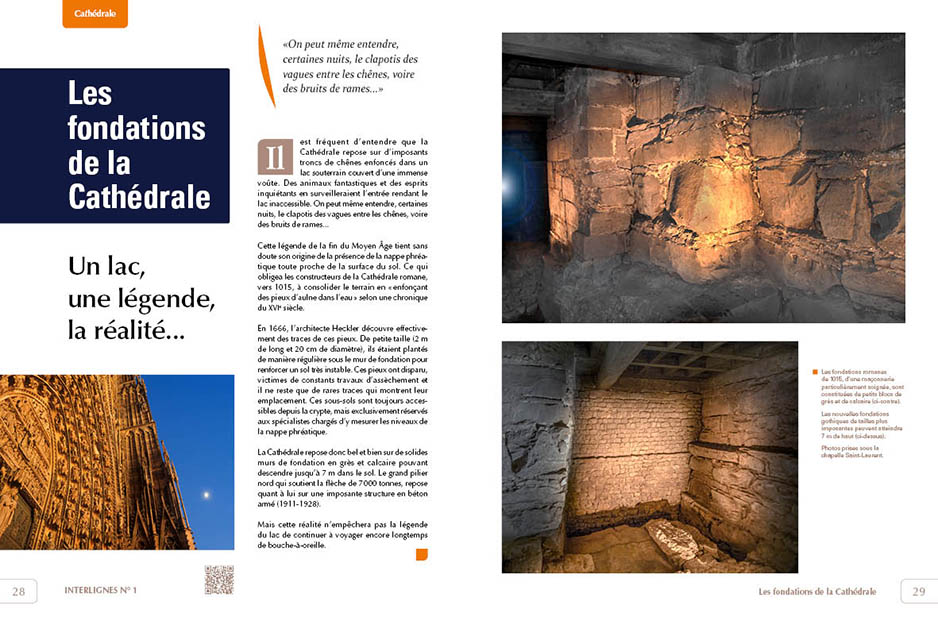
It’s often said that the Cathedral rests on imposing oak trunks embedded in an underground lake. Fantastic animals and disturbing spirits would watch the entrance making the lake inaccessible. We can even hear, some nights, the lapping of the waves between the oaks, even the noise of oars…
This legend of the end of the Middle Ages is probably due to the presence of the water table very close to the surface of the ground. This forced the builders of the Romanesque Cathedral, around 1015, to consolidate the ground by driving small stakes (2m long and 20cm in diameter) evenly under the foundation wall.
These wooden piles have disappeared, but the basements are still accessible from the crypt, to be able to measure the levels of the water table.
The Cathedral therefore rests on solid sandstone and limestone foundation walls that can be as deep as 7m in the ground. The large north pillar supporting the 7,000-tonne spire is based on an imposing reinforced concrete structure (1911-1928).
But this reality will not prevent the legend of the lake from continuing to travel for a long time by word of mouth..
CAVES DES HOSPICES CIVILS DE STRASBOURG
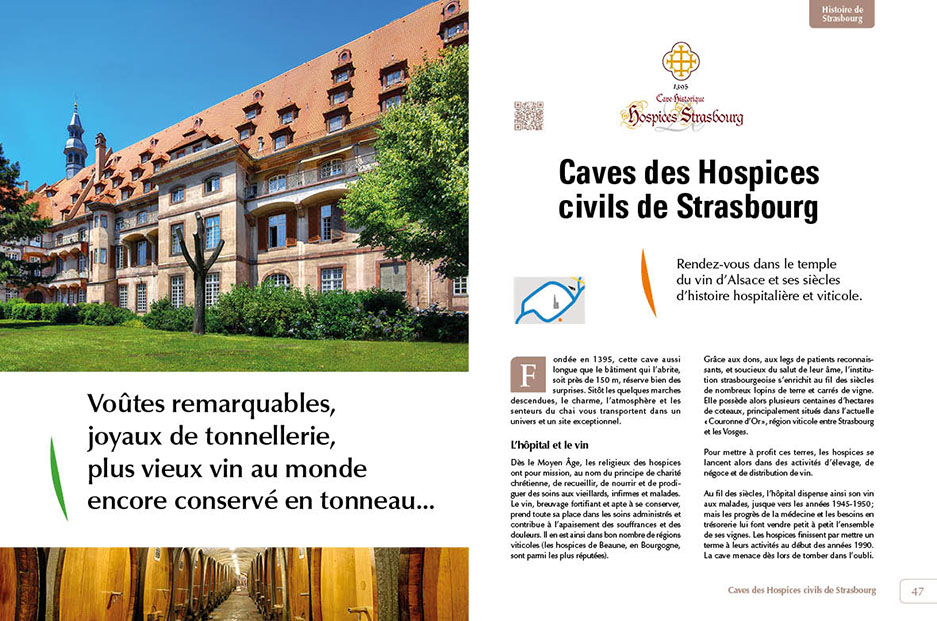
Remarkable vaults, barrels of cooperage, oldest wine in the world still kept in barrel… Let’s meet in the Alsace wine temple and its centuries of hospital and wine history.
Founded in 1395, this cellar has magnificent treasures. In addition to a press of 1727, it also contains an impressive gallery of casks of 100, 200 or 300 years. The oldest wine in the world is preserved as a relic: 400 liters of a legendary vintage of 1472. The last to have tasted it is the General Leclerc in November 1944 (Liberation of Strasbourg).
In the mid-1990s, a handful of winemakers decided to revive the cellar. They organized once a year a blind tasting between professionals, and selected more than forty cuvées. These wines are then carefully aged in the historic barrels (between 6 and 10 months), or more than 140,000 bottles a year.
There is therefore in the center of Strasbourg a showcase of Alsatian viticulture. The cellar contains the wines from the most prestigious Alsatian vineyards that stretch over 170km between Cleebourg and Marlenheim in the north, and Thann in the south.Access: 1 Place de l’Hôpital, 10 min walk from the Cathedral. Tram A or D, Porte de l’Hôpital
- Contact: 03 88 11 64 50
- cave-hospices@chru-strasbourg.fr
- www.vins-des-hospices-de-strasbourg.fr
- Selling shop and free visit from Monday to Friday, 8h30-12h00 and 13h30-17h30 – Saturday 9h00-12h30. Closed on Sundays and holidays
LES BLACK SWANS
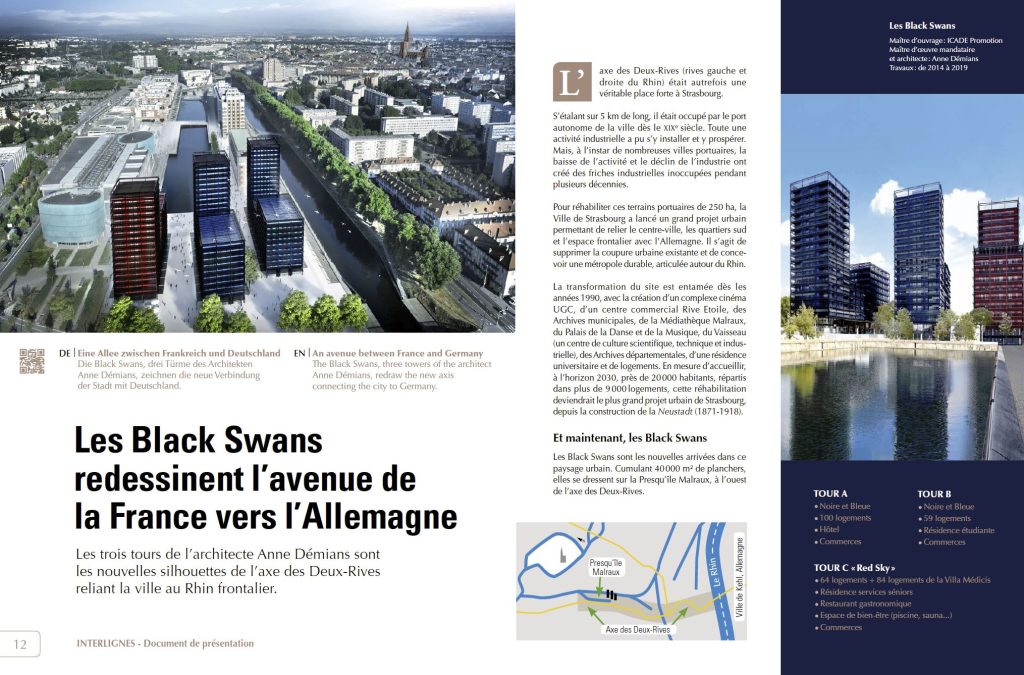
The Black Swans redraw the avenue from France to Germany. The three towers of architect Anne Demians are the new silhouettes of the Deux-Rives axis linking the city to the border Rhine.
Spreading over 5km long, the Deux-Rives axis was occupied by the river port of the city from the nineteenth century. To rehabilitate these port lands, the City of Strasbourg launched a major urban project linking the city center, the southern districts and the border area with Germany. This is to remove the existing urban cut and to design a sustainable metropolis, articulated around the Rhine. In 2030, this renovation would become the largest urban project in Strasbourg, since the construction of the Neustadt (1871-1918), to be able to accommodate almost 20,000 inhabitants.
Three towers, the « Black Swans », are the new arrivals in this urban landscape. The architect Anne Demians (Paris) captures the elegance of the swans, established in these basins, drawing three black silhouettes, arched like ballerinas, playing on the balance between horizontal and vertical lines nearby.
The 3 towers are dressed and enriched by natural lighting effects: at no time of the day, the perspectives are presented in the same way. These towers thus contribute to an additional visual richness in this new landscape of Strasbourg.
PROMENONS-NOUS EN EUROPE
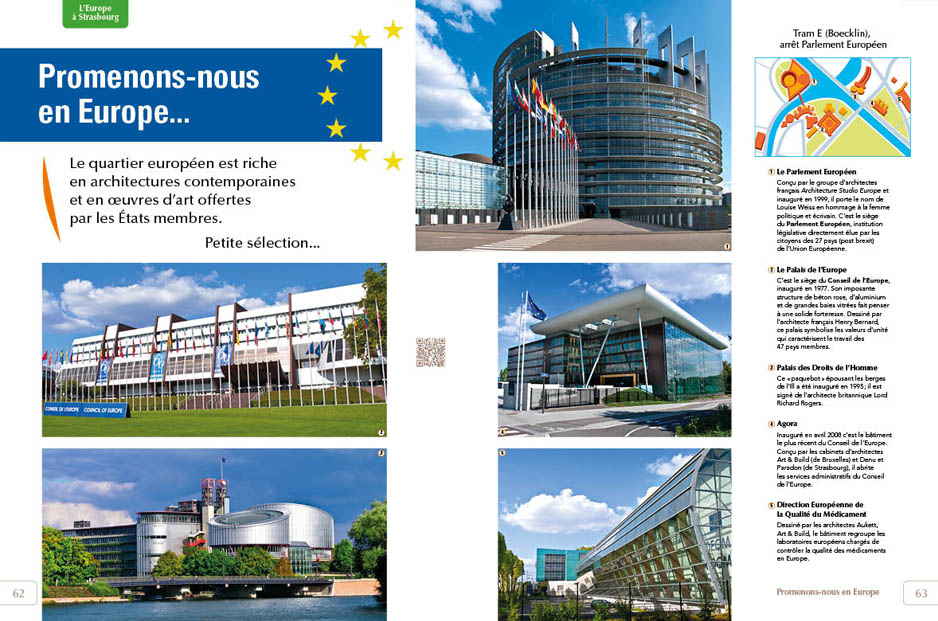
The European quarter of Strasbourg is rich in contemporary architectures and works of art offered by the member states.
Our small selection…
To get to the European district: Tram E direction Roberstau-L’Escale, station European Parliament
1. The European Parliament : Inaugurated in 1999. It’s the seat of the European Parliament, a legislative institution directly elected by the citizens of the 27 countries (post brexit) of the European Union.
2. The Palais de l’Europe : It is the seat of the Council of Europe, inaugurated in 1977. Designed by the French architect Henry Bernard
3. European Court of Human Rights : This « liner like building » following the banks of the Ill was inaugurated in 1995; it is signed by the British architect Lord Richard Rogers.
4. Agora : Inaugurated in April 2008 it is the most recent building of the Council of Europe. It houses the administrative services of the Council of Europe.
5. European Direction for the Quality of Medicine : Designed by the architects Aukett, Art & Build, the building unites European laboratories in change of the quality of medicines in Europe.
6. Europe to Heart : This sculpture of the French artist Ludmila Tcherina represents a man and a woman forming a heart, in homage to Strasbourg, symbol of the reconciliation between the peoples and heart of the European continent.
7. Poseidon, god of the sea : A reproduction of a bronze statue donated by Greece in 1998. The original was recovered in 1928 at Cap d’Artémision in the Aegean Sea and dates back to the year 450 BC. J-C.
8. Human rights : By Mariano González Beltrán representing a circle of men, women and children. A gift of Spain.
9. Four Leaf Clover : A gift of Italy in 1977, this sculpture measures 2 meters high and was made by the artist Attilio Pierelli.
10. Europe : A copper sculpture offered by Austria in 1985.
11. Khachkar : This « cross of stone » embodies the Christology of the Armenian Apostolic Church, which does not represent the death of Christ but his divine nature in a tree of life. The symbolism and know-how of the Khachkars have been listed since November 17, 2010, as UNESCO’s Intangible Cultural Heritage List.
12. Forms : Pietro Cascella’s work, offered by Italy in 1971.
13. Inukshuk : A stacked stone statue measuring 3 meters and made by Percy Tutannuaq. A Canada’s gift to the Council of Europe in 1978.
14. Berlin Wall : In the courtyard of the European Court of Human Rights, you can see a piece of the Berlin wall, in 4 parts (3.60 x 4m), offered by Germany in 1990.
15. The Petrified Seven : Still in the European Court of Human Rights, a work by Carl Bucher, donated by Switzerland in 1995. It expresses the traumatic experiences of physical and psychic violence.
16. Lieu d’Europe : European institutions present in Strasbourg. Who does what ? European Parliament, Council of Europe… Do you want to know more or schedule a visit ?
- See you at the Lieu d’Europe, 8 rue Boecklin, +33 (0) 3 68 00 09 10 – https://lieudeurope.strasbourg.eu
- Animations for children, exhibitions, walks discoveries etc.
17. The kidnapping of Europe : Princess « Europe » brought by Zeus represented as a white bull. This work, made by the Greek brothers Nikos and Pantelis Sotiriadis, weighs nearly 6 tons. It was offered by Crete in 2005.
18. Doppia Bifrontale : Pietro Consagra steel work, donated by Italy in 2003, on the occasion of its presidency of the European Union.
19. AMORE : A sculpture of Pino Tovaglia donated by a group of Italian architects in 1982. It puts together the letters of the word « Amore » entirely carved in marble from the region of Vicenza in Italy.
20. Sicilia for the Europa : A bronze sculpture made by the Sicilian artist Salvatore Fiume. Gift of the region of Sicily in 1992.
21. Giraffe-mann : This sculpture by the German artist Stephan Balkenhof was installed in 2006 at the entrance of the TV station building ARTE.
22. ARTE : Seat of the Franco-German chain inaugurated in 2003. Designed by the architects Hans Struhk (Braunschweig) and Paul Maeckel (Strasbourg), the building forms a large rectangle of 48 by 98 meters placed on the banks of the River Ill.
PLEYEL
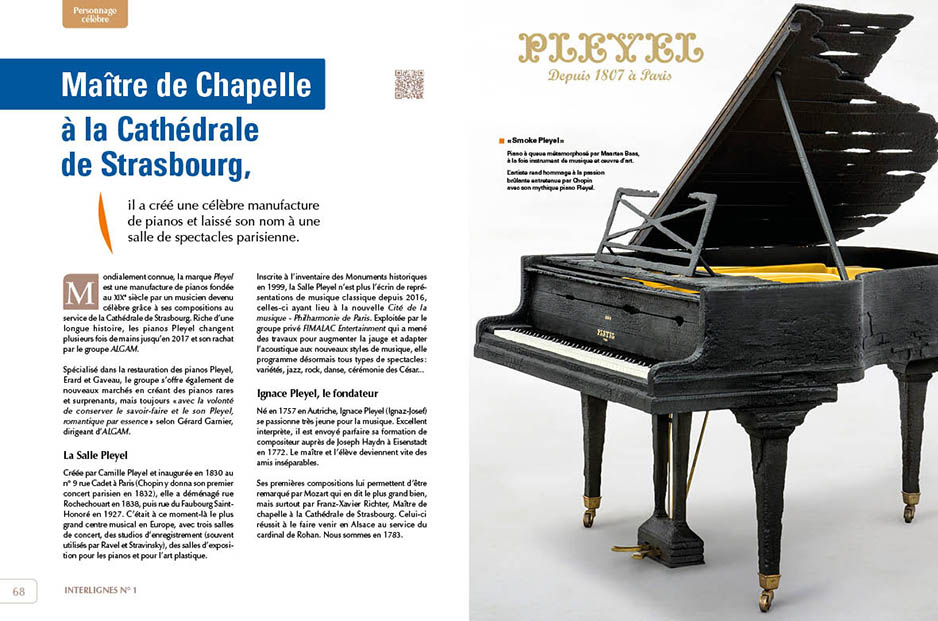
Music director at the Strasbourg Cathedral, he created a famous piano factory and gave his name to a famous Parisian concert hall.
World famous, the brand Pleyel is a piano factory founded in the nineteenth century by a musician who became famous thanks to his compositions at the service of Strasbourg Cathedral. With a long history, Pleyel pianos change hands several times until 2017 with its takeover by the ALGAM group.
The « Salle Pleyel » was inaugurated in 1830 at No. 9 rue Cadet in Paris (Chopin gave there his first Parisian concert in 1832). Moved rue du Faubourg Saint-Honoré in 1927, it was at that time the biggest music center in Europe, with three concert halls, recording studios (often used by Ravel and Stravinsky) and halls exhibition. Listed in the inventory of Historic Monuments in 1999, the « Salle Pleyel » is operated by the private group FIMALAC Entertainment, which now programs all types of shows: variety, jazz, rock, dance, « César » ceremony…
Ignace Pleyel, the founder, was born in 1757 in Austria. His first compositions allowed him to be noticed by Mozart who spoke well of him, but especially by Franz-Xavier Richter, a music Director at the Strasbourg Cathedral, who managed to make him come to Alsace in the service of Cardinal de Rohan.
In January, 1788, he married at the church Saint-Louis in Strasbourg, with Françoise Gabrielle Lefèbvre, daughter of a renowned Alsatian cabinetmaker. Son-in-law and father-in-law got along very perfectly and throught of improving the still very imperfect mechanics of the keyboards of the time.
He exiled a time in London in 1791 to flee the French Revolution, then moved permanently to Paris. In 1807, finally, he created his piano factory. He is associated with his son Camille, born in Strasbourg in 1788. The succession is solidly assured and the family business thrives: the pianos come out of the workshops at a steady pace and become the most famous in Europe. Ignace Pleyel dies on November 14, 1883. Under the impetus of Camille, the company continues to grow with nearly 27,000m2 of workshops, and then goes to the hands of Auguste Wolff, musician and partner of Camille, then to those of Gustave Lyon, son-in-law of Wolff.
But the crisis of the thirties puts an end to this prosperity: the « Salle Pleyel » becomes the property of a bank and the piano factory is liquidated, then taken over by a German group. It will only come back to France in 1994.
In Strasbourg, however, with the exception of a few manuscripts at the municipal library and a street name in a residential quarter, there are few traces of the former Cathedral Master of the Cathedral.
IMAGES :
- page 69 : « Smoke Pleyel »: A grand piano transformed by Maarten Baas, both a musical instrument and a work of art. The artist pays homage to Chopin’s burning passion with his legendary piano Pleyel.
- page 70 : An average of 165 concerts and events are scheduled each year in the « Salle Pleyel ». Examples of shows in 2019: « César » ceremony, The Divine Comedy, Marillion, David Hallyday, The Avener, Marc Lavoine, Étienne Daho, Gossip, Cake…
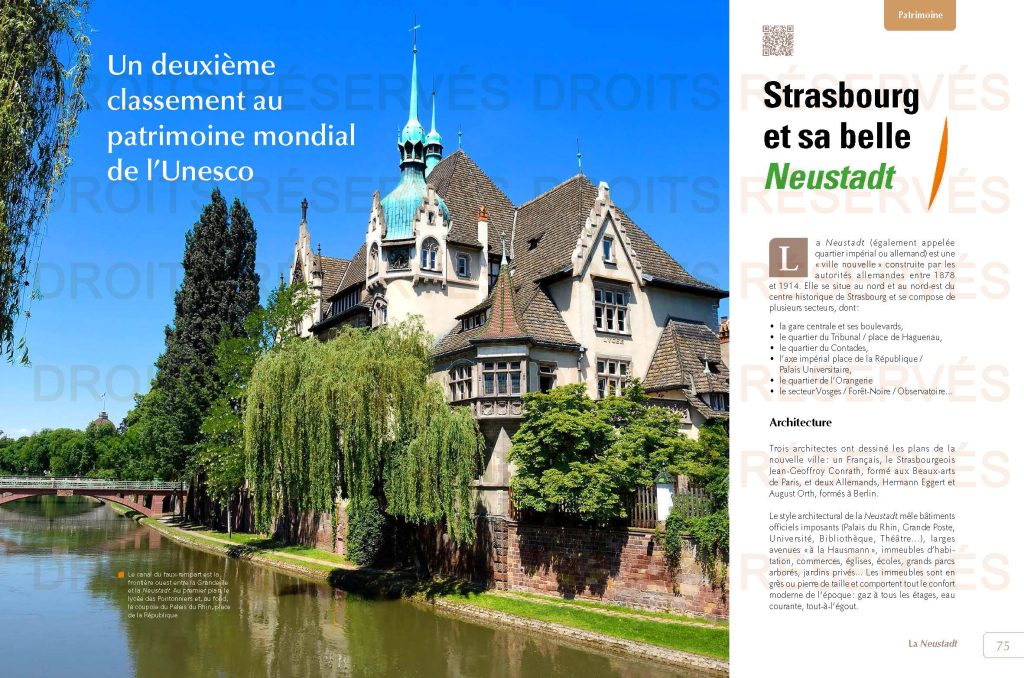
STRASBOURG ET SA BELLE NEUSTADT
A second UNESCO world heritage classification.
« Neustadt » (also called imperial or German district) is a new city built by the German authorities between 1878 and 1914, following the annexation of Alsace-Moselle to the German Empire. It is located north and northeast of the historic center of Strasbourg.
Three architects drew the plans for the new city: Jean-Geoffroy Conrath from Strasbourg, trained at the Beaux-Arts in Paris, and two Germans, Hermann Eggert and August Orth, trained in Berlin. It was to make Strasbourg a showcase of the supremacy and know-how of the powerful German empire.
The architectural style of the Neustadt therefore combines imposing official buildings (Palais du Rhn, Grande Poste, University, Library, Theater …), broad avenues, apartment buildings, shops, churches, schools, large parks trees, private gardens … The buildings are stoneware or stone and have all the modern comforts of the time : gas on all floors, running water, main sewerage.
The different neo styles are mixed in a curious harmony: neo-Romanesque, neo-Byzantine, neo-Gothic, neo-Renaissance, neo-classical, and Art Nouveau style, the « Jugendstil ».
Spared during the two world wars, the Neustadt is a Prussian architectural ensemble of exceptional size and homogeneity that no longer exists in Germany: the Second World War destroyed a large majority of cities across the Rhine. It is considered the best preserved example of German imperial town planning.
Entirely integrated into the contemporary city, the Neustadt is today a strong symbol of the double culture of Strasbourg and its European vocation.
After the Cathedral and the « Grande île » in 1988, a vast area of the Neustadt has been listed as UNESCO World Heritage on 9 July 2017.